
A balance board with its measurements published
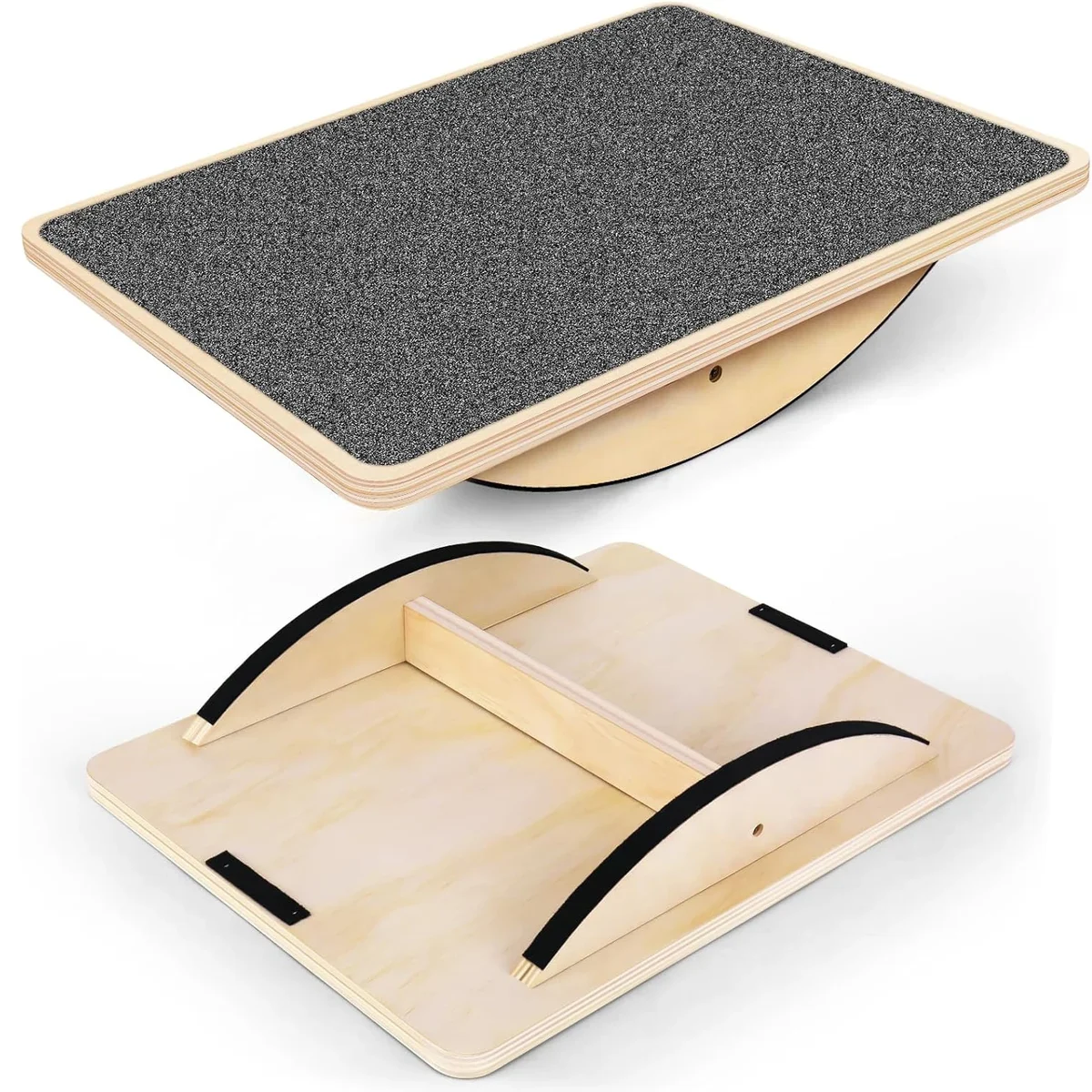
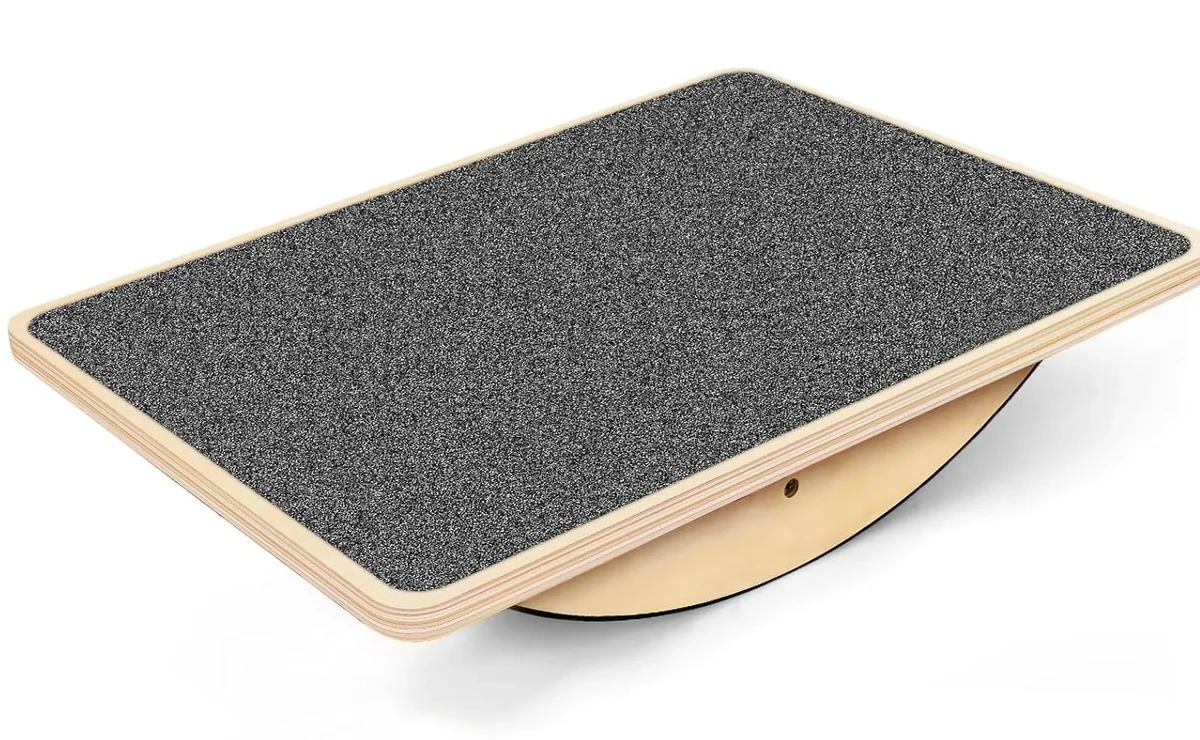
Birch plywood, a grit surface, two curved rails. The deck is 43.5 by 33 centimetres and the board is rated to 158 kilos — numbers you can check against your own foot before you order.
One axis, and the reason that matters
Predictable is not the same as easy. A single-axis board still asks your ankles and calves to work the whole time you stand on it, and the first week on one is humbling. What it does not do is surprise you sideways when you are not ready, which is why it is the shape physiotherapists start people on and the shape that belongs under a standing desk. If you want the unpredictable kind, our guide to balance boards and wobble boards explains which does what, and our wobble board page covers the multi-axis shape in detail.
Three things we can tell you exactly
The deck, measured
43.5 by 33 centimetres, 7.5 centimetres tall at rest.
A EU size 46 foot runs about 30 centimetres. That leaves roughly a finger’s width of board on either side of it — fine for two-footed standing, tight for single-leg work. Measure your own foot and decide before you order.
Birch plywood, all the way through
The plies are visible along all four cut edges.
Deck, rails and spine are the same material. The top carries a bonded grit surface with a border of bare wood around it, and four rubber pads sit under the corners so the board does not slide when it bottoms out.
Rated to 158 kilos
350 lb, from the maker’s own dimension drawing.
A load rating is the one specification that tells you whether a board was built or just assembled. We publish the rated figure.
What we read before we sold this board
Five checks, all of them things you could do yourself. Two of them changed what we published.
| What we checked | Where we found it | What it changed |
|---|---|---|
| Deck dimensions | An annotated drawing published with the product | The specification table gave no measurement at all |
| Load rating | The same drawing: 350 lb | Published as 158 kg rather than converted loosely |
| The attached manual | A PDF on the listing | It describes a different article — other dimensions, other load, other material. We do not use its figures |
| Buyer reports | 14 written reviews on the listing | Two of three long ones call the deck small for a size 46 foot. We say so on the product page |
| Demand, market by market | Measured per country, not translated | German buyers search the English term fourteen times more often than the closest German one — 40,500 against 2,900 a month |
What balance training does, with the certainty attached
Rate of falls, balance and functional exercise versus control (rate ratio 0.76, 95% CI 0.70–0.81; 39 studies, 7,920 participants; high-certainty evidence)
— Sherrington et al., Cochrane Database of Systematic Reviews, 2019
Resistance training alone, on the same outcome, in the same review (rate ratio 1.14, 95% CI 0.67–1.97) — the balance component is what carries the result
— Sherrington et al., Cochrane Database of Systematic Reviews, 2019
Mean single-leg stand time at 60–69 years, falling to 17.2 s at 70–79 and 8.5 s at 80–89 (22 studies, 3,484 participants)
— Bohannon RW, Topics in Geriatric Rehabilitation 22(1):70–77, 2006
Three shapes, three different jobs
| Shape | How it moves | What it suits |
|---|---|---|
| Rocker board (this one) | One axis, on two curved rails | Standing desks, early rehabilitation, learning |
| Wobble board | Every direction, on a dome | Reaction work, later-stage rehabilitation |
| Roller board | One axis, on a loose roller that can shoot out | Board-sport training, for people who already have balance |
The difference is not marketing. In the Cochrane review of 108 trials and 23,407 people, it is the balance and functional component that reduced the rate of falls by 24% at high certainty — resistance work alone did not show an effect. Which shape trains balance best for you depends on what you are training for, and we go through it in how to choose.
The full specification
Measurements, materials and what the maker stands behind
The deck is a rectangle of birch plywood, 43.5 centimetres long by 33 wide, standing 7.5 centimetres tall when it sits level. The corners are rounded and the plies are visible along all four cut edges — the simplest way to see that it is plywood through and through rather than a veneer over something else.
A charcoal grit anti-slip surface is bonded to the top, with a border of bare wood left showing all the way round it. The grit is coarse: it is meant for shoes, and we say that plainly rather than photographing bare feet on it. Underneath, two curved plywood rails run the length of the board, joined by a straight central spine, each with a dark strip along its curved edge. Four rubber pads sit under the corners of the deck so the board does not slide across a hard floor when an edge comes down.
The maker rates it to 350 lb — 158 kilos. That figure comes from the annotated drawing in the manufacturer’s own photo gallery, which is also where the dimensions come from. The specification table carried no measurement at all, and the PDF manual attached to it describes a different article: other dimensions, another load rating, another material. We have asked the seller to confirm in writing, and until they do, the figures on this page are the ones drawn on the product photograph.
What we cannot tell you yet: how it holds up over a year, because we have not sold one for a year. When buyers tell us, that will be on the buyer reports page.
Specifications
| Deck | 43.5 × 33 cm |
| Height at rest | 7.5 cm |
| Material | Birch plywood, deck and rails |
| Surface | Bonded grit anti-slip, bordered by bare wood |
| Underside | Two curved rails, central spine, four rubber corner pads |
| Axes | One |
| Rated load | 158 kg (350 lb) |
| Use with | Shoes |
Dimensions and load rating read from the annotated drawing in the manufacturer’s photo gallery on 15 September 2026. The PDF manual attached to the same listing gives different figures for all three; we treat it as a generic manual attached in error and have asked the seller to confirm.
We have no ratings of our own yet
Stavik is new. There is no star average on this page because there is nothing to average, and a rating without a count behind it tells you nothing. What we can show you is what buyers of this same board wrote elsewhere — including the criticism that repeats: two of the three longest written reviews say the deck is too small for a EU size 46 foot. The measurements agree with them, and we publish the measurements.
The full picture, with the numbers, is on our buyer reports page.
Reviewed and updated 2026-09-15. See how we test.
Questions people ask
How big is the deck, exactly?
43.5 by 33 centimetres, and 7.5 centimetres tall when it sits level. A EU size 46 foot runs about 30 centimetres, which leaves roughly a finger’s width of board on either side of it.
Can I use it barefoot?
The surface is a coarse bonded grit, the same idea as skateboard tape. It is made for shoes, and that is how the manufacturer photographs it in use.
How much weight does it take?
158 kilos, or 350 lb, from the manufacturer’s own dimension drawing.
Is it suitable for children?
This is an adult board: it carries no EN 71 certificate, no CPC, and the maker states no age range. A children’s board is a different object rather than a smaller one, and we explain what to look for in our guide for children.
Will it help with a sprained ankle?
Balance training has real evidence behind it for falls, and ankle work is a common use for a rocker board. This board is not certified rehabilitation equipment, and an injury that is still healing is a question for a clinician rather than for a shop. Our ankle page sets out what the research shows.
Does it work under a standing desk?
That is the size it is built for. It keeps your ankles and calves working while you stand, which makes a standing block less static. It does not replace walking — our page on the 20-8-2 rule explains why we say so.
Where do you ship, and how long does it take?
Germany, Austria, the Netherlands, Belgium and Ireland, in 6 to 10 working days. Details are on our shipping page.
What if it is the wrong size for me?
Thirty days, money back. That is the whole reason we publish the deck dimensions before you order rather than after.
The measurements are on this page. The board is €59.99.
Thirty days to send it back if the deck turns out to be the wrong size for your foot.
Get your Stavik balance board →