
· Ingrid Halvorsen
Balance exercises for seniors: start before the board
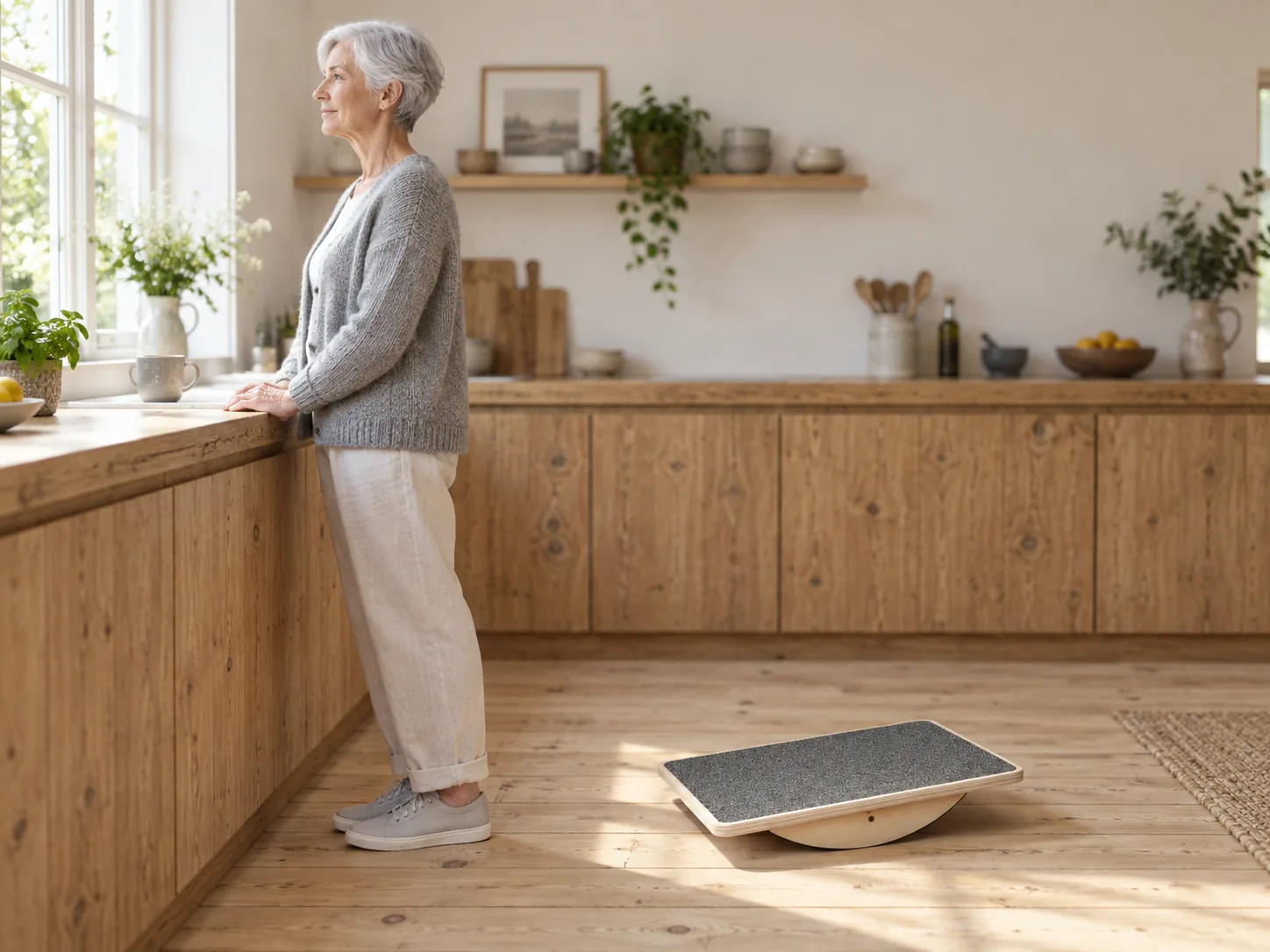
We sell balance boards, and the first thing this page tells you is to not buy one yet. That is not modesty. The evidence behind balance training is strong, but it is evidence about training, not about equipment — and starting on a moving surface is how people give up in week two.
Why this is worth ten minutes a day
The 2019 Cochrane review pooled 108 randomised trials covering 23,407 people across 25 countries. The average participant was 76 years old and 77% were women — which is worth saying plainly, because a lot of exercise research is done on 22-year-old sports science students and then applied to everyone. This one was not.
Participants across 108 randomised trials in 25 countries; average age 76, 77% women — balance and functional exercise reduced the rate of falls by 24% (rate ratio 0.76, 95% CI 0.70–0.81; high-certainty evidence)
— Sherrington et al., Cochrane Database of Systematic Reviews, 2019
The fracture result deserves its own line, with its caveat attached. Among trials of balance and functional training, the number of people who broke something in a fall fell by 56%. Cochrane rated that low certainty — seven trials, few events, a wide interval running from 24% to 75%. It is a real signal and an imprecise one, and you should hold it loosely.
Fall-related fractures, balance and functional exercise vs control (risk ratio 0.44, 95% CI 0.25–0.76; 7 studies, 2,139 participants) — rated LOW certainty
— Sherrington et al., Cochrane Database of Systematic Reviews, 2019
The five, in order
- Feet together, eyes open. Stand with your feet touching, hands resting on the worktop, for 30 seconds. Then try with fingertips only. This is the baseline — if it is hard, everything below waits.
- Heel-to-toe stand. One foot directly in front of the other, as if on a line. Hold 20 to 30 seconds, then swap which foot leads. Narrowing your base is the gentlest way to make balance harder.
- Sit-to-stand, slowly. From a firm chair, stand up without using your hands, and sit back down over a count of three. Five repetitions. This is the one that carries over most directly into real life.
- Heel raises. Hands on the worktop, rise onto the balls of your feet, hold two seconds, lower slowly. Ten repetitions. Slow lowering matters more than height.
- Supported single-leg hold. One hand on the worktop, lift one foot a few centimetres. Hold as long as is comfortable, up to 30 seconds, then swap. Stop the moment the standing ankle starts wobbling hard.
Notice what is not on the list: nothing with eyes closed, nothing on a soft or moving surface, nothing unsupported. Those come later, and for some people they never need to come at all.
How long should you be able to hold?
A meta-analysis pooled 22 studies and 3,484 people aged 60 to 99, measuring single-limb stance with the eyes open.
| Age | Mean hold | 95% confidence interval | Basis |
|---|---|---|---|
| 60–69 | 27.0 s | 20.4 – 33.7 s | 11 studies · 851 people |
| 70–79 | 17.2 s | 11.6 – 22.8 s | 12 studies · 870 people |
| 80–99 | 8.5 s | 1.0 – 16.1 s | 6 studies · 146 people |
Bohannon, Topics in Geriatric Rehabilitation 22(1):70–77, 2006. Overall mean across all ages: 15.7 seconds.
Look at the bottom row. The interval runs from 1 second to 16 — the variation within an age band is far wider than the gap between bands. Which means comparing yourself to the average of your decade tells you very little. Comparing yourself to your own number from last month tells you a great deal.
What the evidence says about the alternatives
Two findings from the same review are worth knowing before you choose how to spend the time. Tai Chi reduced the number of people who fall by 20%, and that particular result was rated high certainty across eight trials — it is a genuine option, not a soft one. Meanwhile programmes that were primarily strength training, without a balance component, showed no demonstrated benefit on falls at all.
| Approach | Effect on rate of falls | Certainty |
|---|---|---|
| Balance and functional exercise | −24% | High |
| Multiple types combined | −34% | Moderate |
| Tai Chi | −19% | Low (but high for number of fallers) |
| Strength training alone | No demonstrated effect | Very low |
Sherrington et al., Cochrane Database of Systematic Reviews, 2019.
Strength work is worth doing for other reasons. But if the goal is specifically not falling, the balance component is the one carrying the result.
People experiencing one or more falls under Tai Chi vs control (risk ratio 0.80, 95% CI 0.70–0.91; 8 studies, 2,677 participants; high-certainty evidence) — a real alternative if standing exercises do not appeal
— Sherrington et al., Cochrane Database of Systematic Reviews, 2019
The reviewers also checked whether these programmes only help people who are already falling, and found no evidence of a difference: the effect held whether or not a trial selected participants at increased risk. If you are steady on your feet and wondering whether this applies to you, it does.
When does a board start to add something?
If you get there, start on the most stable board you can find, next to the same worktop, and work through the progression from its first step rather than its fifth. A single-axis rocker is gentler than a multi-axis one — the difference is explained in balance board or wobble board. If the goal is a specific ankle rather than general steadiness, an ankle board is a narrower tool again, and a wobble board is the multi-axis version of the same idea.
Two pages worth more than a product page: what the evidence actually shows, and the downsides, which includes the plain fact that harm from balance training is poorly recorded rather than proven absent. When you do want to choose, our comparison starts from criteria and how we test says what we check. The range is here when you want it.
One thing this page cannot do
If you have already fallen, if you feel dizzy when you stand, if your blood pressure drops when you get up, or if you take medication that affects balance, the useful next step is a conversation with your GP or a physiotherapist — not a list on a website. Falls have causes that exercise does not address, and finding out which ones apply to you is worth more than any of the five exercises above.
Sources: Sherrington C, Fairhall NJ, Wallbank GK, Tiedemann A, Michaleff ZA, Howard K, Clemson L, Hopewell S, Lamb SE. Exercise for preventing falls in older people living in the community. Cochrane Database of Systematic Reviews, 31 January 2019 · Bohannon RW. Single Limb Stance Times: A Descriptive Meta-Analysis of Data From Individuals at Least 60 Years of Age. Topics in Geriatric Rehabilitation 22(1):70–77, 2006. Last reviewed 15 September 2026.