
How to choose a balance board
There is no "best balance board", and a page that ranks five of them without telling you what it measured is selling you the ranking. What follows is the criteria, the reason each one matters, and — the part nobody writes — where to find the numbers when the listing does not show them.
Where the specifications are actually hidden
This is worth knowing before anything else, because it changes how you read a product page. The specification table on a marketplace listing is often four fields — material, brand, model number, department — and none of them is a measurement. The numbers are usually further down the same page, in one of two places: inside an attached manual, or drawn as annotations across one of the gallery photographs. Open both, and read them against each other.
Adult boards we examined closely that published deck dimensions in the specification table. Both published them elsewhere on the same page: one as annotations drawn across a gallery photograph, one inside an attached PDF manual whose figures contradict that same listing's own photograph. A small sample — but check your own listing before assuming it is better
— Stavik sourcing review, marketplace listings, 2026
When we did that on one board, the attached manual gave a deck of 60 × 30 × 5 cm, a maximum load of 120 kg, a stated age range of 12 to 60, a requirement to wear grippy shoes rather than train barefoot, and an explicit line that the product must not be used as a toy. None of that was in the listing. All of it changes who the board is for — which is exactly why it is worth opening.
The six criteria, in order of how much they matter
1. How many axes it tips on
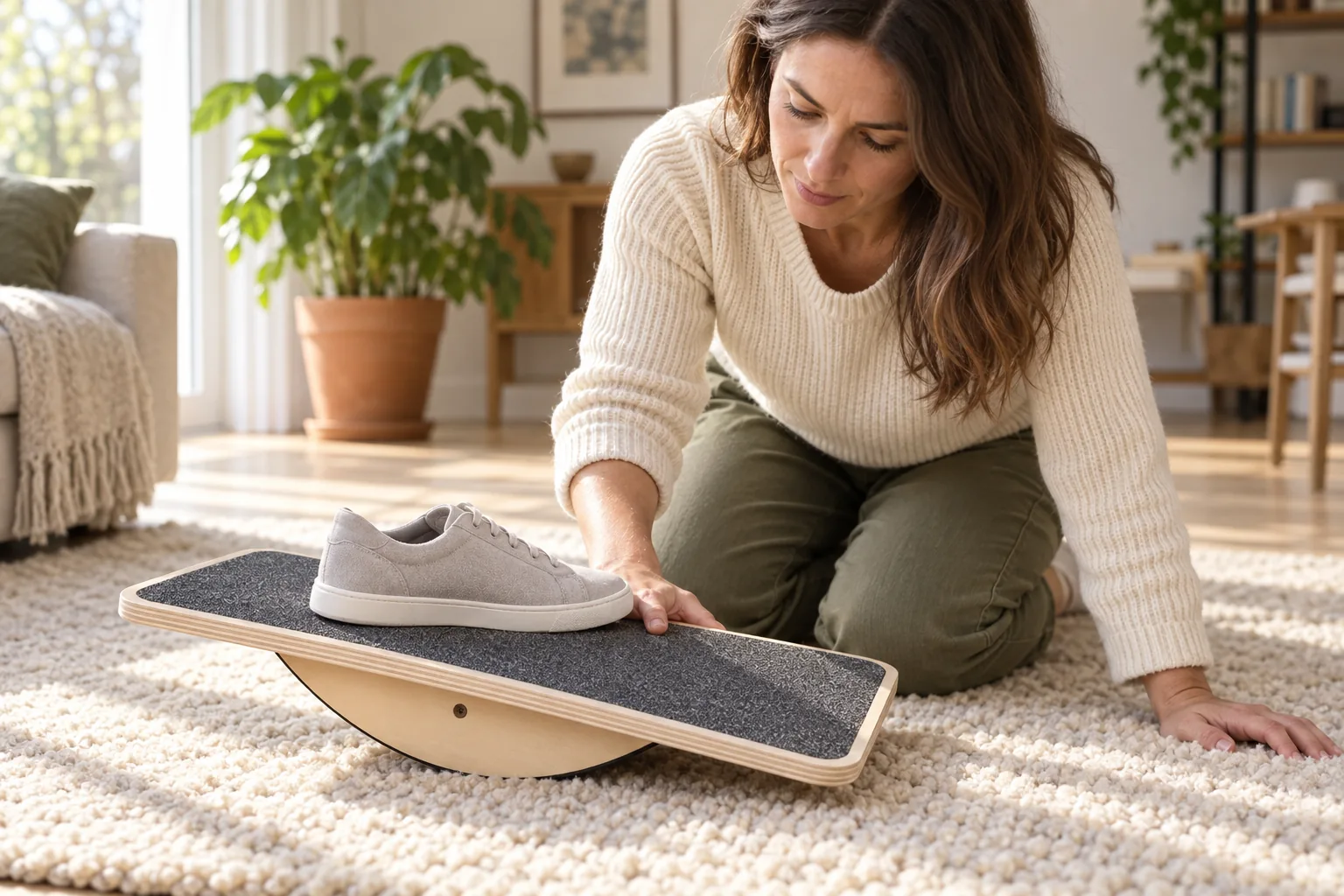
A rocker on a half-cylinder tips one way and back. A disc on a dome tips in every direction. Single-axis is predictable and suits long standing and early rehabilitation; multi-axis is unpredictable and suits reaction work. This is the difference that changes the exercise, and we go through it in balance board or wobble board.
2. Deck length against your foot
The most common complaint we found in buyer reviews of a desk-sized board was that the surface was too small — from two separate reviewers wearing a EU size 46. The deck measures 43.5 by 33 centimetres, and a EU size 46 foot runs about 30 centimetres: that leaves barely a finger's width of board on either side of the foot, which is what those reviewers were describing. Single-leg work at the end of a progression needs a deck wide enough for one foot to sit fully on it. Measure your own foot and compare; do not trust "one size".
3. Load rating
Commonly stated around 120 kg in this category. The number matters less than whether it is published at all: a maker who states a limit has thought about the failure mode, which on a wooden board is the deck cracking. A listing with no rating is not telling you it is strong.
4. Surface grip
Look for a stated friction figure or, failing that, a described surface treatment. One manual we read specified a non-slip rubber base with a friction coefficient of at least 0.8 and prohibited barefoot use outright. Grip is the difference between a board that slides on a hard floor and one that does not.
5. The stated age range
Adult boards in this category commonly exclude under-12s and over-60s explicitly. That second exclusion surprises people, given that the strongest evidence for balance training comes from trials whose average participant was 76. It reflects the manufacturer's liability position, not the science — but it is still what you are buying. Balance exercises for seniors starts from the floor for exactly this reason.
6. Whether it is certified for children
If a child will use it, this is not a preference. A board intended for children falls under toy safety rules — EN 71 in Europe, CPSIA and a children's product certificate in the United States — and adult boards commonly carry an explicit statement that they are not toys. A supplier logo on a listing is not a test report. The guide for children covers this properly.
What price does not buy
The 2019 Cochrane review pooled 108 trials and 23,407 people and found balance and functional exercise reduces the rate of falls by 24%, rated high-certainty evidence. Nowhere in that classification does apparatus appear. It is the most useful thing to know before comparing two boards eighty euros apart.
Rate of falls, balance and functional exercise vs control (rate ratio 0.76, 95% CI 0.70–0.81; 39 studies, 7,920 participants; high-certainty evidence) — classified by exercise type, never by equipment
— Sherrington et al., Cochrane Database of Systematic Reviews, 2019
There is a second reason not to over-think the purchase. In the same review, falls that required medical attention dropped by 39% among people who exercised. That outcome was reported by only five of the trials and rated low certainty, so hold it loosely — but it is a reminder that the decision worth agonising over is whether you will train, not which board you train on.
People experiencing one or more falls requiring medical attention, exercise vs control (risk ratio 0.61, 95% CI 0.47–0.79; 5 studies, 1,019 participants) — rated LOW certainty, only 5 of 89 trials reported it
— Sherrington et al., Cochrane Database of Systematic Reviews, 2019
A checklist you can take to any listing
| Check | Where to look | If it is missing |
|---|---|---|
| Deck dimensions | Manual PDF, not the spec table | Ask the seller before buying |
| Axes of movement | Photos and video | Assume single-axis if it sits on a half-cylinder |
| Load rating | Manual, sometimes the description | Treat as unstated, not as unlimited |
| Surface / grip | Manual, close-up photos | Plan to use grippy shoes regardless |
| Age range | Manual — rarely the listing | Do not assume a child may use it |
| Toy certification | Test report, not a logo | Not suitable for children, full stop |
Where to go next
If you have not decided whether you want one at all, what the evidence shows and the downsides are the two pages to read first. If you know what you want it for, the shape matters more than the brand: wobble boards, desk boards and ankle boards are three different objects. How we test sets out what we check, and you can see our range whenever you want.
Questions people ask
What is the most important thing to check before buying a balance board?
The deck dimensions, and you often will not find them in the specification table. On the listings we examined, the measurements were inside the PDF instruction manual attached to the page — or absent entirely. A board that does not publish its deck length is a board you cannot match to your feet.
Does a more expensive balance board work better?
Not on the evidence. The trials behind balance training tested exercise types, not equipment, and plenty of the effective programmes used no equipment at all. Price buys you finish, load rating and durability. It does not buy you a different training effect.
What load should a balance board be rated for?
Manufacturers in this category commonly state a maximum around 120 kg, and they state it for a reason: the failure mode on a wooden board is the deck cracking under load. Check that the figure is published at all before you compare figures.
Can adults and children use the same balance board?
Usually not, and the maker will often say so. Adult boards in this category carry stated age ranges and explicit statements that the product is not a toy. A children's board is a different object under different safety rules, not a smaller version of the same thing.
Source: Sherrington C, Fairhall NJ, Wallbank GK, Tiedemann A, Michaleff ZA, Howard K, Clemson L, Hopewell S, Lamb SE. Exercise for preventing falls in older people living in the community. Cochrane Database of Systematic Reviews, 31 January 2019. Listing and manual observations: Stavik sourcing review, September 2026. Last reviewed 15 September 2026.