
· Ingrid Halvorsen
The downsides of using a balance board
We sell balance boards. That makes this page harder to write than the usual listicle, and it also makes it the one worth writing: nearly every page answering this question tells you the risk is "minimal" and moves on to a buy button. The trial data says something more interesting, and more uncomfortable.
What the trials actually recorded
The 2019 Cochrane review is the largest synthesis of exercise and falls that exists. Its section on harms is short, and the reviewers were blunt about why: the reporting was poor. Only one trial in the whole review monitored adverse events closely in both the exercise group and the control group. Everywhere else, harms were counted in the group that was exercising and not in the group that was not — which makes the numbers impossible to compare.
Serious adverse events across the entire review — one pelvic stress fracture and one inguinal hernia surgery, both in a single trial, out of 27 trials and 6,019 participants that reported harms at all
— Sherrington et al., Cochrane Database of Systematic Reviews, 2019
Narrowing to the exercise type that matters here — gait, balance and functional training — the picture is the same shape. Fifteen of the 48 relevant trials reported on adverse events at all. Two hundred events were reported in total, but 173 of those came from a single study. The remainder included four participants with shortness of breath and one with palpitations. One study reported a pelvic stress fracture in an intervention group.
Of the 200 adverse events reported across balance and functional training trials, 173 came from one single study — the distribution is not what a well-recorded dataset looks like
— Sherrington et al., Cochrane Database of Systematic Reviews, 2019
The reviewers rated the evidence on adverse events very low certainty, and downgraded it by three levels because no trial in that analysis measured harms in both groups throughout the trial. Their own summary of the evidence says the reporting was poor. That is not the same as saying balance training is dangerous. It is also not the same as saying it is safe — and a page that tells you the second thing is telling you something the data does not support.
| What the review found | Figure | Certainty rating |
|---|---|---|
| Trials reporting adverse events at all | 27 of 108 | — |
| Of those, trials reporting none | 14 | — |
| Trials monitoring both groups closely | 1 | — |
| Serious adverse events, whole review | 2 | Very low |
| Median events per exercise group | 3 (range 1–26) | Very low |
Sherrington et al., Cochrane Database of Systematic Reviews, 2019.
The downside nobody measures: you have to keep doing it
This is the real cost, and it never appears in a risk section because it is not a risk — it is an attrition problem. The Cochrane reviewers noted the duration of the effective programmes explicitly, and drew the practical conclusion themselves: the benefit comes from continuing. A board bought in January and shelved in March has not reduced anybody's risk of anything.
The duration of most effective exercise programmes in the review, with nearly one-third lasting a year or more — the effect is a function of persistence, not intensity
— Sherrington et al., Cochrane Database of Systematic Reviews, 2019
If five minutes on most days sounds like more than you will actually do, start by standing on one leg while the kettle boils, and buy a board when that has become a habit. Our exercise progression starts from the same place.
Four situations where a board is the wrong tool
- An ankle that still gives way. Chronic instability responds well to balance training — a 2024 review of nine trials and 341 patients found that — but it responds well to supervised balance training with a starting point set by someone who examined the joint. Buy the board after that conversation, not instead of it.
- A recent injury inside the healing window. Nothing on this site can tell you where that window ends for you.
- Dizziness or blackouts of unexplained origin. A board makes the symptom more likely to matter, not less.
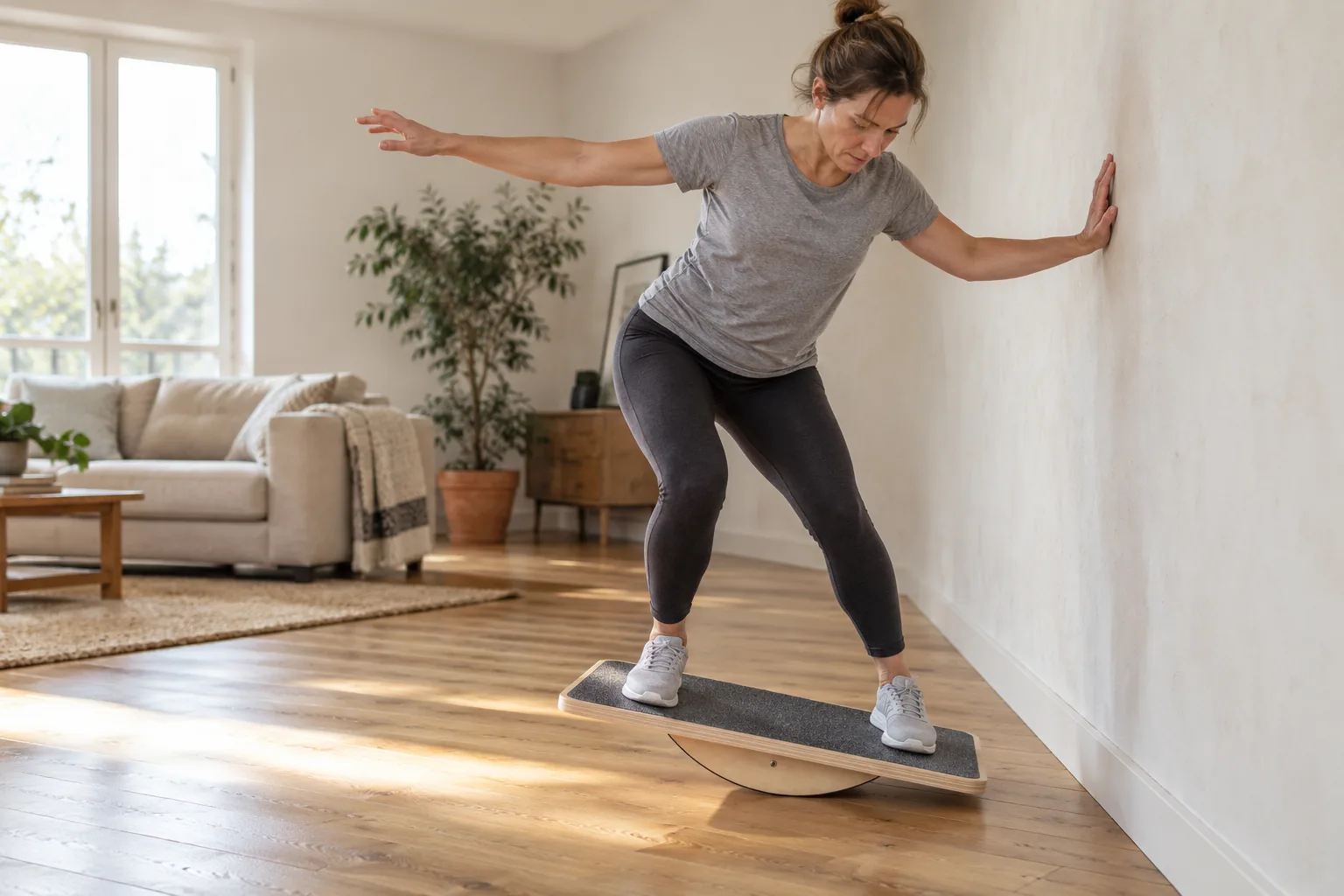
- Nothing to hold on to. Not a medical objection, a practical one. If the room has no wall or worktop within arm's reach, the first three weeks are worse than they need to be.
What the manufacturers themselves exclude
Worth reading the instruction sheet of whatever board you are considering, because the exclusions are often broader than the marketing. Boards in this category commonly carry a stated age range, a maximum load, a requirement to wear grippy shoes rather than train barefoot, and an explicit statement that the product is not a toy. Those are not formalities — they define what the maker will stand behind.
They also explain why a children's board is a different object rather than a smaller one, which we cover in the guide for children. And why an ankle board and a standing desk board are not interchangeable despite both being flat pieces of wood you stand on.
Where that leaves the decision
On the benefit side the evidence is unusually good: balance and functional exercise reduces the rate of falls by 24%, and Cochrane rated that high certainty. On the harm side the evidence is thin and badly collected, and the summary is that we do not know as precisely as we would like. Those two sentences sit oddly together, and anyone telling you otherwise has simplified one of them.
We go through the benefit side properly in whether balance boards actually work. If you are deciding between board shapes, balance board or wobble board sets out the difference, and our comparison starts from criteria rather than products. For older beginners, balance exercises for seniors starts further back. You can see what we sell whenever you want — there is no hurry from our side.
Source: Sherrington C, Fairhall NJ, Wallbank GK, Tiedemann A, Michaleff ZA, Howard K, Clemson L, Hopewell S, Lamb SE. Exercise for preventing falls in older people living in the community. Cochrane Database of Systematic Reviews, 31 January 2019. Chronic ankle instability figures: Guo Y, Cheng T, Yang Z, Huang Y, Li M, Wang T, Systematic Reviews, 2024. Last reviewed 15 September 2026.